
Workday burst onto the ERP scene a few years ago as a streamlined, user-friendly alternative to more traditional ERP platforms.
Started by two of the same leaders behind PeopleSoft, Workday was meant to address many of the common gripes about Peoplesoft and other traditional ERP systems built on pre-2000s architecture.
Organizations across the board are considering a move to Workday. So what’s driving Workday’s popularity as the ERP system of choice?
Cost
ERP systems are expensive. The constant upgrades are expensive. The need to hire consultants and project teams to lead upgrades is expensive.
One of Workday’s greatest appeals is the substantially lower cost following initial implementation. It’s important to keep in mind that as with any ERP system, the initial implementation of Workday is typically no less expensive. In the long-run though, Workday is able to reduce the cost through two of its other advantages: universal upgrade, and modern interface. The universal upgrade prevents organizations from having to constantly undertake costly upgrades, and the modern interface makes it easier for business partners and employees to buy-in, and in some situations can reduce the cost of training. More to come on both of these areas.
Universal upgrade
Workday was designed from day one to be a cloud-based system, separating it from most other ERP systems which were originally designed prior to the cloud revolution, and then forced to adapt.
As such, every user of Workday is on the same version; every user is upgraded to new versions automatically. This approach eliminates one of the most frustrating aspects of traditional ERP systems – the ongoing need for upgrades. By turning over responsibility for conversions to Workday, organizations no longer need to shoulder the burden and cost of planning and managing upgrades.
For organizations that require heavy customization, or tight control over upgrades, Workday’s one-version-for-all approach can be problematic. The ability to customize is nearly non-existent, and upgrade timelines are determined by Workday rather than the organization.
Modern interface
As a system built following the digital revolution, Workday’s interface feels far more modern and fresh; more akin to your iPhone or Facebook than most of the older, clunky ERP interfaces.
The modern, more intuitive feel often eases the adoption of Workday for business partners, and employees. The Workday app receives constant updates bringing it in line with modern innovative tech companies, rather than large-scale ERP companies that typically lag behind.
Better reporting
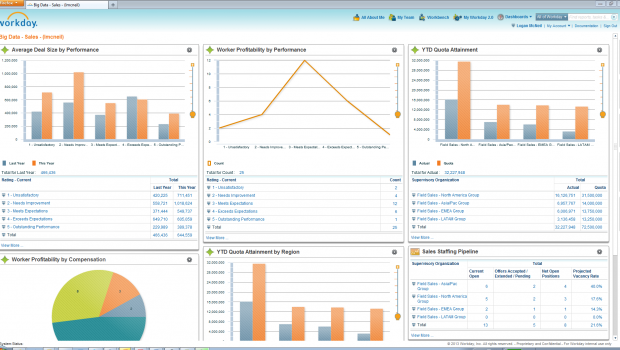
The modern interface helps Workday to excel in the reporting space. Organizations that make the switch, often note that Workday offers reporting that provides greater insight with actionable data allowing managers to move more quickly to make needed changes.
Workday has often lead the way in introducing trailblazing reporting in recent years. They frequently work directly with some of their flagship clients to craft new reporting and analytical functionalities that meet their clients’ needs.
Interested in learning more about Workday? Let’s talk!